Simone Touseau: Not a Spy, But Stripped Naked? A Heart-Wrenching Story Like Malena’s
We often hear heroic stories about war, right?
About brave heroes fighting, about independence, about victory.
But have you ever thought about the much more heartbreaking stories behind the scenes that are often forgotten?
Stories that aren’t just about gunfire, but about emotional wounds, humiliation, and injustice that stick to the soul?
Well, one story that gives me chills and reminds me of the great movie Malena is the true story of Simone Touseau.
Maybe her name isn’t as famous as other historical figures, but what she went through, I swear, it’s truly gut-wrenching.
Who Was This Simone Touseau?
Imagine this: August 18, 1944. France had just been liberated from the grip of the Nazis.
The atmosphere was euphoric everywhere, people were celebrating their long-awaited freedom.
But amidst that joy, there was one scene that makes us think: “How could this happen?”
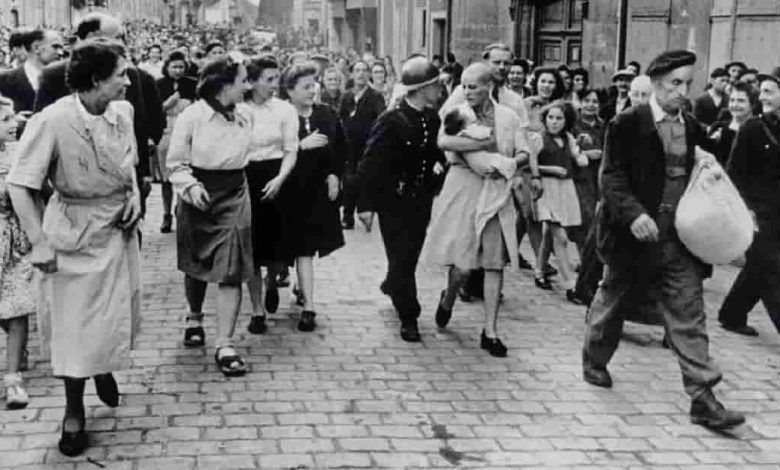
A young woman, her name was Simone Touseau, she was only 23 years old. She was dragged through the streets of Chartres, a city in northern France, her head shaved bald, clutching her baby tightly.
She was publicly humiliated!
Why?
Because of “love.” Yep, she was accused of having a relationship with a German soldier.
The iconic photo of this moment was taken by the legendary war photographer, Robert Capa.
In it, we can see Simone’s expression of trying to hold back the shame, while cradling her daughter who, ironically, was the child of that German soldier.
A silent “proof” of her “guilt.” That photo isn’t just an image, but a historical document that speaks volumes about anger, revenge, and individual suffering amidst collective turmoil.
This Wasn’t About Treason, But “Revenge Masquerading as Justice”

It’s really important to emphasize: Simone was not a traitor. She was also not a spy.
There was absolutely no evidence that she helped the enemy, provided important information, or engaged in any military collaboration.
But simply because she had a relationship (whether it was true love, forced for survival amidst hunger and economic hardship, or a combination of both, we’ll never know the true details) with a German soldier, and had a child from that relationship, that was enough to “seal her fate.”
What Simone experienced was not an isolated incident in post-war France. Just imagine, about 20,000 French women were treated like this!
This was part of a phenomenon called “épuration sauvage” or “wild purges” after the liberation.
Many of these women were punished without a proper trial, without a chance to defend themselves.
They were publicly humiliated, their hair shaved (as a symbol of “cleansing” or “erasing” shame), their bodies marked, paraded around, and some were even severely harmed.
This was more like collective revenge disguised as justice.
A newly liberated country, with a mix of euphoric victory and the trauma of occupation, trying to “heal itself” by finding scapegoats among its own people.
Heartbreaking, isn’t it?
This practice occurred throughout France, from large cities to small villages.
Motives varied: there was pure anger towards collaborators, personal vendettas, and also simply following the crowd.
Ironically, many men who genuinely collaborated politically or economically with the Nazis often escaped such severe punishments, while women who “merely” had personal relationships became the target of brutal public anger.
This highlights a clear gender bias in these “purges.”
The “Femmes Tondues” and “Horizontal Collaboration”

The women who suffered this public humiliation were often referred to as “femmes tondues,” which literally translates to “shorn women” or “shaved women.”
The act of publicly shaving their heads was a deeply symbolic and degrading punishment. It stripped them of their femininity, their dignity, and marked them as outcasts.
It was a visual representation of their perceived “impurity” and a stark warning to others.
This treatment was closely tied to the concept of “horizontal collaboration,” a term used to describe intimate or sexual relationships between French women and German occupation soldiers.
Unlike “vertical collaboration,” which referred to political or economic cooperation with the enemy, “horizontal collaboration” was largely about personal relationships.
While some of these relationships might have been genuine romances, many were born out of necessity, a way for women and their families to access food, protection, or other resources in a time of extreme scarcity and hardship.
Regardless of the circumstances, these women were often seen as having “betrayed” the nation’s honor through their bodies, making them prime targets for public shaming during the emotionally charged period of liberation.
Why Is This Story So Similar to the Movie Malena?
Now, here’s where the strong resemblance to the movie Malena, starring Monica Bellucci, comes in.
That film tells the story of Malena whose beauty became a boomerang during wartime in a Sicilian village, Italy.
She was gossiped about, looked down upon, humiliated, and eventually became the target of a brutal mob.
Let’s break down the specific similarities:
1. Women as Targets of Mob Anger and Judgmental Morality
Both Simone Touseau and Malena, they both became targets of public anger and frustration.
They weren’t war criminals, but they were seen as “tainting” the honor of the nation or community.
In Simone’s case, it was her relationship with the enemy.
In Malena’s case, it was her beauty that sparked jealousy and rumors, especially when her husband was presumed dead and she had to find ways to survive.
This shows how, in times of crisis, morality is often unfairly projected onto women.
2. Punishment Without Fair Legal Process
This is a crucial point!
Simone’s head was shaved and she was humiliated without a trial, without proof, based only on accusations and mob anger.
In the movie Malena, too, Malena was beaten, had her hair forcibly cut, and was driven out of town without any trial to prove her guilt.
This shows how fragile justice and legal systems can be in difficult post-conflict times, where mob emotions often override the principle of due process.
3. Life-Destroying Social Stigma (and Legacy)
After that incident, Simone Touseau lived in solitude, “quietly hurting,” until she died at the age of 44 (1966). Her life was destroyed.
She never recovered from the trauma of public humiliation.
Malena in the movie also experienced the same; she had to leave her hometown due to the stigma attached to her.
This wasn’t just about physical punishment, but also about being socially and psychologically punished for life.
This stigma often carried over, affecting children born from such relationships.
The Plight of Simone Touseau’s Child and Other “War Babies”
The presence of Simone Touseau’s child in Robert Capa’s iconic photo adds another layer of profound tragedy.
This innocent baby, fathered by a German soldier, became a living testament to her mother’s “shame” and a visible symbol of the “horizontal collaboration.”
These children, often referred to as “war babies,” faced immense challenges. They carried the stigma of their German fathers and their French mothers’ perceived betrayal.
Many were ostracized, bullied, and grew up in a society that often viewed them with suspicion or resentment.
Their existence was a painful reminder of the occupation, a burden they carried through no fault of their own.
This aspect of the story highlights how the trauma of war extends beyond the immediate combatants, affecting generations.
The “Trotsky in Copenhagen” Effect – How Narratives Shape Perception
While the specific details of Trotsky in Copenhagen (referring to Leon Trotsky’s speech in Copenhagen in 1932, discussing the nature of the Russian Revolution and historical materialism) might seem unrelated to Simone Touseau’s story at first glance, it subtly points to a broader concept relevant here: how powerful narratives and historical interpretations can shape public perception and action.
Trotsky’s speech, and indeed his entire intellectual output, was about understanding and framing historical events, defining who is hero and who is villain, and influencing collective consciousness.
In a similar vein, the “épuration sauvage” that Simone Touseau endured was fueled by a dominant post-liberation narrative that demonized any connection to the German occupiers, regardless of nuance or individual circumstances.
This narrative effectively labeled certain groups (like the “femmes tondues”) as symbols of national impurity, allowing for their public shaming to be perceived as a form of justice or a necessary purification, rather than what it often was: mob violence fueled by collective trauma and the desire for swift revenge.
This parallel reminds us that historical events are not just about facts, but also about the stories we tell ourselves about those facts, and how those stories can justify profound injustices.
The narrative of national purity and retribution in post-war France overshadowed the individual complexities and human suffering of women like Simone.
The Hidden Wounds Behind Victory
Simone Touseau’s story is a very powerful reminder.
We often remember war from the perspective of victory, from the heroic side, from the casualty numbers on the battlefield.
But we often forget that behind that victory, there are countless hidden personal sufferings.
The suffering of civilians, of women, of children who are innocent victims of conflict and post-conflict “purges.”
Simone Touseau lived in silence and sorrow after that dark day. She died relatively young, perhaps due to constant emotional distress.
This is a real example of how “revenge” can destroy a person’s life, even without concrete proof of “treason” that could be legally tried.
A mere romantic relationship and a child were enough to seal her fate.
So, let’s try to look at history not only through the eyes of the victors.
There are many “Simone Touseaus” in various conflicts around the world, from World War II to modern conflicts, whose bitter stories may never be recorded in history books or are just forgotten footnotes.
This story teaches us about empathy, about the moral complexities in times of war, and about the importance of true justice, not just “revenge disguised as justice.”
It’s truly heartbreaking, isn’t it?


