Ho Chi Minh’s Hidden Son Who Was Kept Secret All This Time: Who Would’ve Thought?
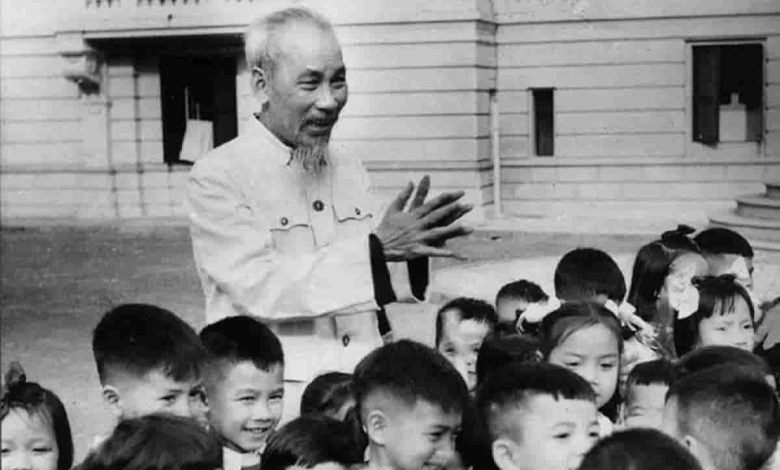
Who doesn’t know Ho Chi Minh? His name is certainly etched in history as Vietnam’s tenacious and tireless revolutionary leader.
In many people’s eyes, he was “Uncle Ho,” fully dedicated to the struggle for independence, so much so that a myth emerged of him living a celibate life, as if “married” to the ideal of revolution.
The impression was that he was so focused, he had no time or interest for personal matters like love or family. This heroic image was built so strongly, it even became a vital part of Vietnam’s national narrative.
However, as often happens in history, behind the perfect public image are layers of more complex and human stories.
Information circulating in certain circles, and now increasingly discussed, reveals something different.
The idea that Ho Chi Minh was celibate turns out to be far from the truth. Some even liken it to how Adolf Hitler also built a “solitary” self-image for his ideology.
This shows how great leaders often use personal narratives as political tools.
In fact, Ho Chi Minh is described as quite a charming and charismatic figure. Not only because of his leadership prowess but also his ability to speak fluently in various languages: French, Russian, English, Mandarin, and Cantonese, in addition to his native Vietnamese.
Imagine, a leader who could interact with various international parties without language barriers.
This reveals another side of Ho Chi Minh, adaptable and possessing strong personal appeal, which certainly could attract others, including the opposite sex.
The Secret Relationship with Nông Thị Xuân and the Birth of Nguyễn Tất Trung
Among his personal relationships, one stands out the most, sparking much speculation and investigation: his connection with Nông Thị Xuân.
She was a young woman said to have been Ho Chi Minh’s mistress in the early 1950s.
It’s important to note that the term “mistress” at that time might have had a different social context in Vietnam, but essentially it indicates a relationship outside of formal marriage.
The culmination was the birth of a son. According to the testimonies of some “insiders” who were very close to Ho Chi Minh’s circle and had access to sensitive information, in late 1956, Nông Thị Xuân gave birth to a son by Ho Chi Minh.
The boy was named Nguyễn Tất Trung.
This is quite a surprising fact, considering Ho Chi Minh was born in 1890, meaning he was already 66 years old when Trung was born.
Quite an elderly age to have a child, and this adds a dimension of humanity to a figure often depicted as “above” worldly matters.
Concealment, Tragedy, and Nguyễn Tất Trung’s Hidden Life
So, why was Trung’s existence never known to the public?
This is the core of the mystery. Nguyễn Tất Trung’s birth was kept strictly secret from the wider society.
The reason was highly political: to maintain Ho Chi Minh’s image as a celibate revolutionary, whose entire life was dedicated to the nation, with no time for personal pleasures or family ties.
Amidst a difficult struggle, the image of a pure and unblemished “Father of the Nation” was crucial for maintaining public morale and unity.
The existence of a child could be seen as disrupting this narrative, even potentially creating political vulnerabilities.
Sadly, Nông Thị Xuân’s story ended tragically. In 1957, just a year after Trung’s birth, Nông Thị Xuân died in a vehicle accident.
There have been various speculations about her death, whether it was purely an accident or if there were other deliberate factors to keep this secret buried.
However, officially, her cause of death was an accident.
After his mother’s passing, Nguyễn Tất Trung was raised with a different identity and lived in secrecy.
He moved among various households of families loyal to Ho Chi Minh’s cause.
This meant Trung grew up unable to openly experience a father figure, and unable to publicly acknowledge his lineage.
His life must have been filled with isolation and mystery, far from the public eye.
The Revealed Descendants
Time marched on, and as the decades passed, information about Nguyễn Tất Trung began to surface. His personal story, once whispers in limited circles, is now increasingly discussed.
In 1988, Nguyễn Tất Trung got married. And in 1992, he himself had a son.
This means that Ho Chi Minh actually had grandchildren!
A fact that might surprise many who have only known the myth of his celibacy.
As of 2025, the latest information states that Ho Chi Minh’s only known son, Nguyễn Tất Trung, is a retired army colonel.
He now has one adult son and two grandchildren. They are Ho Chi Minh’s only known descendants. This shows that Ho Chi Minh’s bloodline did not end, even though its existence was kept secret for decades.
This story offers a richer and more human perspective on Ho Chi Minh. He was not just an unblemished revolutionary icon, but also a man with a complex private life, secrets, and ultimately, descendants.
It’s a reminder that behind the grand narratives of history, there are always personal stories waiting to be uncovered, providing a more complete and honest picture of the figures who shaped our world.
Key Facts and Legacy
While the focus of this article is on his hidden family, Ho Chi Minh’s life was vast and impactful. Here are some additional key facts:
Ho Chi Minh’s Birth and Early Life
He was born Nguyễn Sinh Cung on May 19, 1890, in Hoàng Trù village, Nghệ An province, French Indochina (now Vietnam).
He adopted the name “Ho Chi Minh” (meaning “He Who Enlightens”) much later in his life. His father, Nguyễn Sinh Sắc, was a Confucian scholar and a district magistrate.
Ho Chi Minh received a traditional Vietnamese education, heavily influenced by Confucianism, before venturing abroad.
Ho Chi Minh’s Education and Global Travels
His education was largely self-taught and gained through extensive travels.
From 1911, he spent over 30 years living in various countries, including France, the United States, the United Kingdom, and the Soviet Union.
During this time, he worked odd jobs (from a kitchen helper on a ship to a pastry chef) and became involved in communist and anti-colonial movements, studying Marxist-Leninist theories and honing his political skills.
This global exposure profoundly shaped his revolutionary ideology.
Ho Chi Minh’s Wives and Family (Beyond Nông Thị Xuân)
The notion of him being celibate is a historical myth.
While Nông Thị Xuân and their son, Nguyễn Tất Trung, are the most prominent cases discussed in recent years due to their direct lineage, historical records and various accounts suggest Ho Chi Minh had other significant relationships.
He is believed to have married Tăng Tuyết Minh (Zeng Xueming), a Chinese woman, in Guangzhou in 1926.
However, this marriage was not officially recognized by the Communist Party, and their relationship ended as he continued his revolutionary activities across different countries.
He never publicly acknowledged any spouse or family members to maintain his image as solely dedicated to the revolution.
His “family” was portrayed as the Vietnamese people themselves.
Was Ho Chi Minh a Good Leader?
Assessing if Ho Chi Minh was “good” is complex and depends on perspective.
For Vietnamese nationalists and communists, he was an extraordinary, visionary, and highly effective leader who successfully liberated Vietnam from French colonial rule and resisted American intervention.
His strategic brilliance, ability to unify disparate factions, and unwavering dedication to independence are widely praised.
He was seen as a father figure (Uncle Ho) to his people, inspiring immense loyalty.
From a Western or anti-communist perspective, he might be viewed more critically due to his communist ideology and the human cost of the wars he led.
However, even his staunchest critics acknowledge his remarkable leadership qualities and his profound impact on 20th-century history.
Why Was Ho Chi Minh Important?
Ho Chi Minh’s importance is immense:
- Architect of Vietnamese Independence: He led Vietnam’s struggle for independence from French colonial rule (First Indochina War) and later played a crucial role in the resistance against American intervention (Vietnam War).
- Founding Father of Modern Vietnam: He founded the Viet Minh, the Democratic Republic of Vietnam (North Vietnam), and the Communist Party of Vietnam.
- Symbol of Anti-Colonialism: His success inspired many other liberation movements worldwide, making him an icon of anti-colonial struggle in the 20th century.
- Master Strategist: His guerrilla warfare tactics and political acumen allowed a smaller, less technologically advanced nation to defeat powerful adversaries.
How Did Ho Chi Minh Die?
Ho Chi Minh died on September 2, 1969, at the age of 79, from heart failure in Hanoi.
He did not live to see the reunification of Vietnam, which occurred in 1975. His death was a significant moment, but the war continued for several more years.
What Happened After Ho Chi Minh Died?
After Ho Chi Minh’s death, his successors, Lê Duẩn, Phạm Văn Đồng, and Võ Nguyên Giáp, continued the war effort with renewed determination, often invoking his name and legacy.
The North Vietnamese military, supported by the Soviet Union and China, eventually defeated South Vietnam and the United States in 1975, leading to the reunification of Vietnam under communist rule.
His legacy remained a powerful unifying force, and his embalmed body is still preserved and displayed in a mausoleum in Hanoi, a testament to his enduring reverence in Vietnam.
His vision for a unified, independent Vietnam was ultimately realized, albeit after years of devastating conflict.


