Unpacking the Brutality of the Dirlewanger and Kaminski Brigades: More Than Just “Disgusting to the Nazis”
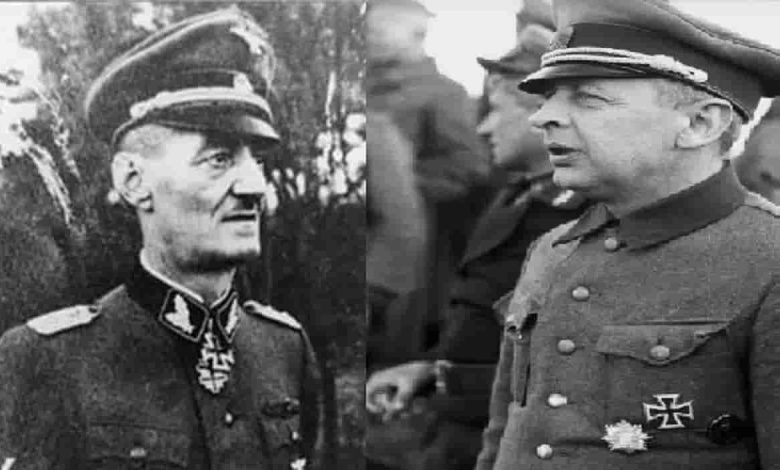
There are some stories from World War II so horrific that even the perpetrators and their leaders were shocked.
This is precisely the case with the Dirlewanger Brigade and the Kaminski Brigade.
They weren’t just “SS units,” but rather incarnations of human brutality and depravity that are hard to comprehend. Let’s delve deeper.
The Dirlewanger Brigade
Let’s start with the Dirlewanger Brigade, a unit whose name will forever be etched in history as one of the most heinous.
Leader and Unit Background
Behind this atrocity was Oskar Dirlewanger, an individual whose very profile is deeply disturbing. Dirlewanger wasn’t just an “ordinary criminal.”
He was a necrophiliac, an alcoholic, and a serial rapist. Even before the war broke out, he had been imprisoned for the rape of a minor.
However, what’s horrifying is how the Nazi regime, which supposedly championed “purity,” actually saw value in Dirlewanger’s madness.
His doctorate (a PhD in Political Science!), which had been revoked due to his criminal acts, was reinstated.
This wasn’t because he was reformed, but because Heinrich Himmler, the head of the SS, saw “potential” in him.
Himmler needed someone ruthless, devoid of morals, and willing to undertake the most vile tasks that even regular army soldiers or other SS units would shy away from.
In short, Dirlewanger was the perfect tool for the dirtiest of purposes. The members of this brigade were not trained soldiers.
They were a collection of convicted criminals released from prisons and concentration camps, including murderers, rapists, and other hardened felons.
Imagine a military unit composed of the most criminal elements of society, led by a psychopath, and given absolute freedom to act. This was a perfect recipe for disaster.
Unimaginable Atrocities
The Dirlewanger Brigade’s brutality began in the most horrific place: concentration camps. They were assigned as guards, and it was here that they demonstrated their “creativity” in torture.
Prisoners were not only killed but also tormented in extremely sadistic and inhumane ways. Reports mention mutilation, mass rape, and burning people alive.
Later, the unit was sent to Belarus for “anti-partisan” operations.
This was a euphemism for clearing areas of anyone suspected of opposing the Nazi occupation, most of whom were innocent civilians.
Here, the Dirlewanger Brigade carried out a systematic campaign of terror:
- Village Burnings: They would lock villagers inside barns or houses, then set them on fire, burning them alive. Anyone who tried to escape would be shot or pushed back into the flames.
- Mass Rape: Women and girls of all ages became victims of brutal rape, often in front of their families.
- Torture: Civilians were tortured for information or simply for pleasure. Torture methods often involved mutilation and horrific abuse.
- Plunder: After the atrocities, villages would be thoroughly looted.
Even Wehrmacht (German Army) units and other SS units operating in the region often protested the Dirlewanger Brigade’s brutal methods.
They considered Dirlewanger’s actions not only ineffective in “fighting partisans” but also counterproductive as they only fueled more popular resistance. However, Himmler always protected Dirlewanger.
Role in the Warsaw Uprising
The most infamous (and most shameful) moment for the Dirlewanger Brigade was their role in the suppression of the Warsaw Uprising in August-October 1944.
After being decimated by the Red Army during Operation Bagration, the unit was reformed and sent to Warsaw.
In Warsaw, they became the spearhead of brutality in crushing the Polish rebellion.
They were responsible for the Wola Massacre, where tens of thousands of civilians, including women and children, were slaughtered within days.
They made no distinction between combatants and non-combatants. Rape, looting, and the burning of the city became their modus operandi.
Paradoxically, amidst this savagery, Dirlewanger was even promoted to SS-Oberführer (equivalent to Brigadier General) and awarded the Knight’s Cross of the Iron Cross, one of Germany’s highest military decorations.
This illustrates how the Nazi regime valued extreme brutality if it served their objectives.
Oskar Dirlewanger’s Final Fate
After the war ended, Oskar Dirlewanger was captured by French forces in the town of Altshausen in June 1945.
Although there are some conspiracy theories about his escape, most historians agree that he died in custody on June 7, 1945.
Reports indicate that he died as a result of brutal beatings by enraged Polish prison guards. His death, if true, was a fitting end for someone who had sown so much suffering.
The Kaminski Brigade
Next, let’s explore the story of the Kaminski Brigade, a unit that also left a dark stain on the history of World War II.
Origins and Commander
The Kaminski Brigade, also known as the Russian National Liberation Army (RONA), was a unique Waffen SS unit. Its members were not ethnic Germans, but rather Soviet citizens, predominantly ethnic Russians, who chose to collaborate with the Nazis.
They were formed from the remnants of the “Lokot Republic,” an autonomous entity established under German occupation.
Their commander was Bronislav Kaminski, a charismatic but brutal individual.
Kaminski managed to gather thousands of desperate or anti-Soviet people, forming them into a military unit that pledged allegiance to the Nazis.
Atrocities and Loss of Control
Similar to the Dirlewanger Brigade, the Kaminski Brigade was also notorious for its atrocities against civilians and other military units.
They were known for:
- Massacres and Looting: In Belarus and Russian territories, they carried out mass killings of villagers and plundered property.
- Poor Discipline: This unit was famously undisciplined. They often acted at will, ignored orders, and engaged in robbery and violence against civilians even in German-held areas.
- Systematic Rape: Rape was rampant among its members, often indiscriminately.
Their brutality reached its peak when they were sent to help suppress the Warsaw Uprising in 1944.
In Warsaw, the Kaminski Brigade participated in the same atrocities as Dirlewanger. They engaged in widespread looting, rape, and mass killings that were incredibly savage.
However, their truly uncontrolled behavior ultimately backfired. Other German units, including the Wehrmacht and even some SS units, were disgusted and repulsed by the Kaminski Brigade’s conduct.
They not only damaged Germany’s image but also disrupted military operations due to their indiscipline.
Dissolution and Kaminski’s Fate
The extreme indiscipline and brutality led the Nazi leadership to eventually decide that the Kaminski Brigade was too dangerous and unreliable.
In August 1944, Kaminski and his senior staff were summoned to SS headquarters in Łódź. There, Kaminski was executed by the Gestapo.
The official reason for his death was that he was killed by Polish partisans, but in reality, he was executed for his unit’s uncontrolled actions and the crimes they committed.
Even by the brutal standards of the Nazis, Kaminski was deemed to have crossed a line.
After Kaminski’s death, the remnants of his unit were absorbed into other collaborationist units, specifically into the Russian Liberation Army (ROA) under General Andrey Vlasov. However, their infamous reputation persisted.
Lessons from Depravity
The stories of the Dirlewanger Brigade and the Kaminski Brigade are chilling reminders of extreme dehumanization in war.
They show that in the midst of conflict, there are human boundaries that can be crossed, and when they are, the result is unimaginable suffering for the victims.
Dirlewanger’s case also highlights how totalitarian regimes can manipulate and utilize the most depraved individuals to achieve their goals, even to the extent of promoting them for their atrocities.
Meanwhile, Kaminski’s case demonstrates that even within the circle of collaborators, there are lines that should not be crossed, and violating them can have fatal consequences.
These two units represent some of the darkest chapters in human history, and a deep understanding of their actions is crucial so that we always remember the cost of unchecked hatred and brutality.


